Canal Convergence Turns 15 This Fall. City Hall Just Started Grading It.
September 24, 2026
September 24, 2026
If you're eating out in Old Town this week, you're already inside the calendar's first big beat of fall. Arizona Restaurant Week runs through September 27, and Old Town's chefs have been trading turns in the spotlight: Chef Russell walking people through ZuZu's kitchen at Hotel Valley Ho, Chef Kyle Swesey previewing what Olive & Ivy is plating, Chef Jennie Goldsberry doing the same for Luna by Giada. It's a nice week. It is not the big one.
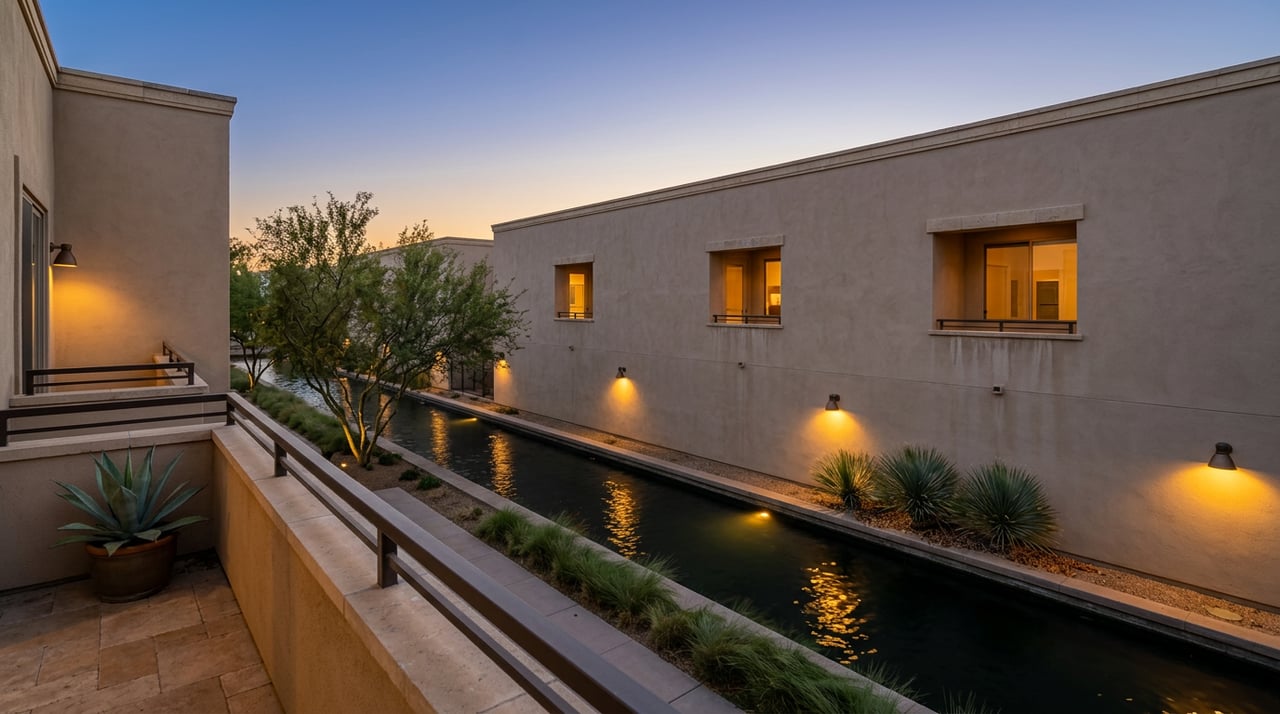
The big one lands November 6 through 15, when Canal Convergence returns to the Scottsdale Waterfront for its 15th year, a free, ten-night run of light art along the Arizona Canal that Entertainment Solutions, Inc., the contractor handling the festival's infrastructure and street closures, estimates will draw somewhere between 100,000 and 125,000 people. That's not new information if you've lived here longer than one autumn. What's new is that this year, the festival is running under a level of financial scrutiny it has never faced before, and the theme organizers picked for 2026 reads less like a curatorial whim and more like a direct answer to the question the city just started asking out loud: what is this actually worth?
You'll see at least one guide floating around calling this year's theme "Most Western." That's not what Scottsdale Arts, the nonprofit that runs the festival, or Experience Scottsdale are calling it. The official theme is Western Nature, and the distinction matters more than it sounds like it should. Jennifer Gill, the festival's deputy director and curator, described the intent as being "excited to explore the beauty and diversity of the American West through a variety of artistic lenses this year." That's a festival about ecology, water, and the physical West, not a festival about cowboy nostalgia.
The installations back that up. In Theory Art Studios, the Utah-based team behind last year's rainbow-lit "polychroma," is returning with "grandmother turtle," an illuminated steel sculpture built around a desert tortoise form, with petroglyph work by Santa Clara Pueblo artist Nora Naranjo-Morse and poetry from Arizona Poet Laureate Laura Tohe laser-cut into the shell. The same studio is also showing "the weight of light," a crystalline lightning-bolt piece that stays dormant until a visitor's touch triggers a burst of light and a rumble of thunder.
A few more worth knowing before you go:
None of that is filler dressed up as spectacle. Water, desert flora, drought, and the mythology of the frontier are the actual subject matter, which lines up with something the festival has never had to say out loud before this year: it needs to justify itself in terms the city can measure.
Here's the part that doesn't show up in a typical festival roundup. In February 2026, the Scottsdale City Council voted 5-2 to attach stricter accountability metrics to Scottsdale Arts' annual municipal operating agreement, worth $6.3 million a year. That vote happened at the same time Scottsdale Arts CEO Gerd Wuestemann was telling the city that Canal Convergence alone generated roughly $12 million in economic impact. Put those two numbers next to each other and you get the actual story: a council that funds an arts organization nearly twice over what one of its events reportedly returns, deciding it wants better proof of that return going forward.
| What | Figure | Context |
|---|---|---|
| Festival run | Nov. 6-15, 2026, 6-10 p.m. nightly | 15th edition, coinciding with Scottsdale's 75th anniversary |
| Estimated attendance | 100,000 to 125,000 visitors | per Entertainment Solutions, Inc., the festival's operations contractor |
| Scottsdale Arts' city operating agreement | $6.3 million annually | Council voted 5-2 in Feb. 2026 to add stricter accountability metrics |
| Reported festival economic impact | $12 million | figure reported by Scottsdale Arts CEO Gerd Wuestemann |
Zoom out further and the stakes get clearer. Old Town draws nearly half of the city's overnight visitors and anchors a tourism economy that Experience Scottsdale credits with $3.5 billion in annual economic output and $74 million in city tax revenue, a figure cited by the Fountain Hills Times. When a council starts asking pointed questions about a $6.3 million line item, it's not because the money is trivial to the city's bottom line. It's because that bottom line is now big enough that everyone wants to know exactly which parts of it are pulling weight.
This is where Western Nature stops being just a pretty theme and starts looking like a strategic one. The city's Advanced Water Treatment Plant, which processes recycled wastewater into purified drinking water, sits inside the same civic conversation about resource stewardship that the festival's water-and-light installations are visually built around. Canal Convergence has always staged itself on the Arizona Canal, a 42-mile waterway that Salt River Project began building in 1883 and that today forms the northernmost stretch of a 131-mile regional distribution system. Army Chaplain Winfield Scott bought land along that same canal in 1888 to found the settlement that became Scottsdale. A festival about desert ecology, staged on the infrastructure that made the desert livable in the first place, timed to a year when the city is turning 75 and asking its funded arts organization to prove its worth in dollars, isn't a coincidence of scheduling. It's the closest thing to a thesis statement an art festival can make without saying it outright.
You can feel that same 75th-anniversary energy outside the festival gates too. Rusty Spur Saloon, the Main Street institution, is marking its own 75th birthday on September 26 with live country music and a fundraiser for Phoenix Children's Foundation. The anniversary isn't just a marketing peg for one nonprofit's fall calendar. It's something the neighborhood's older businesses are genuinely counting toward.
None of the strategy above changes how you should actually spend an evening on the canal, so here's the practical version. The festival grounds are anchored by the Soleri Bridge and Plaza, the Paolo Soleri-designed structure completed in 2011 that sits at the heart of the Waterfront installations. Parking is spread across four main options: the Galleria Garage at 4301-4343 N. Scottsdale Road, the Fifth Avenue Garage at 7143 E. Fifth Ave., the underground garage at 7135 E. Camelback Road beneath the Waterfront itself, and the Craftsman North lot at 4252 N. Craftsman Court. All of it runs free during the festival, which is more than you can say for most ten-night events pulling six figures in attendance.
If you've walked this stretch of the canal on a normal Tuesday, you already know the rhythm shifts hard once the installations go live at 6 p.m. and hold through 10. Weekend nights will be the crowded ones this year especially, given the double anniversary pulling in both regulars and out-of-towners curious what a 15-year-old free festival looks like when it's sharing a birthday with the whole city. If you want the art without the crowd math, a weeknight visit gets you the same nine installations with a fraction of the foot traffic, and it gives you an actual conversation with the gallery staff and volunteers stationed along the route, something that gets harder to come by once the Saturday crowd fills in.
Most people walking the canal in November will see fire, light, and a giant illuminated turtle, and that's a completely reasonable way to spend an evening. But if you live here, it's worth knowing you're also watching a nonprofit try to answer a question the city just started asking with real teeth: does this event earn the money the city puts behind it. The theme this year says the answer is yes, and it says so in a language built entirely out of the water, land, and history that made this stretch of canal worth building a city around in the first place.
That's the kind of detail that tends to matter to people who've put down roots here, not because it changes anything about buying or selling a home, but because it's the texture that makes a neighborhood feel like yours instead of a place you're just passing through. Frank Realty Group spends as much time walking Old Town's streets as writing about them, and if a night on the canal ever gets you wondering what your own corner of the neighborhood is worth these days, we're always glad to talk it through.
Stay up to date on the latest real estate trends.
Jobey, Andy and the Frank Realty Group are dedicated to giving you an exceptional experience in your home buying and selling process. Contact us today to start your journey!